
Thai phrases for travel: Helpful words for Backpackers
Some links in this post are affiliate links. This means if you purchase something through my links I may make a small commission at no extra charge to you. See my disclaimer.
Thailand is a tropical paradise with spicy food, bustling cities, dense jungles and some of the friendliest people on Earth, so it would be a huge shame to visit and not communicate with the locals.
As one of the most popular gap year destinations worldwide, people travel from all over to eat pad thai and satay dishes, and one thing that makes their experience a little more authentic is having a few Thai phrases memorised and ready to go to ease their communication concerns while they travel.
Unlike most European languages, Thai uses a completely different alphabet and characters, making it much harder to read without structured lessons. However, with the age of the internet, it’s easier than ever to pick up some phrases, meet with tutors and learn the basics, including Thai, so that’s what this article aims to do. So you can enjoy your trip and focus on the fun aspects, more so than the logistics.
| Country: | Thailand |
| Currency: | Thai Baht / THB / ฿ |
| Do you need a visa to visit as a tourist? | Check here |
As someone solo travelling the world since 2015, I have made the effort to learn at least some Thai travel phrases for each time I visited so I could better communicate with the locals. I’ve tried to do the same thing for each country I have moved to or visited, and found it makes a huge difference to how the locals perceived me each time.
I started out with online apps each time, but found my pronunciation was often wrong, so I decided to try using native tutors on Preply (I still use them to this day before every new trip), and the difference has been huge. I was able to pronounce words correctly and communicate more easily.
Politeness is Determined by Your Gender – But Not In the Way You Think
Feminine and masculine words are prevalent in many languages; however, the way they are used is different in Thai.
If you want to speak politely (which is advised as the default), then you should include the following gender suffixes after everything you say. It’s not compulsory, but Thai people will appreciate your politeness much more than if you were to speak impolitely or too casually.
Instead of the individual words being treated as masculine and feminine, the difference comes from the person speaking.
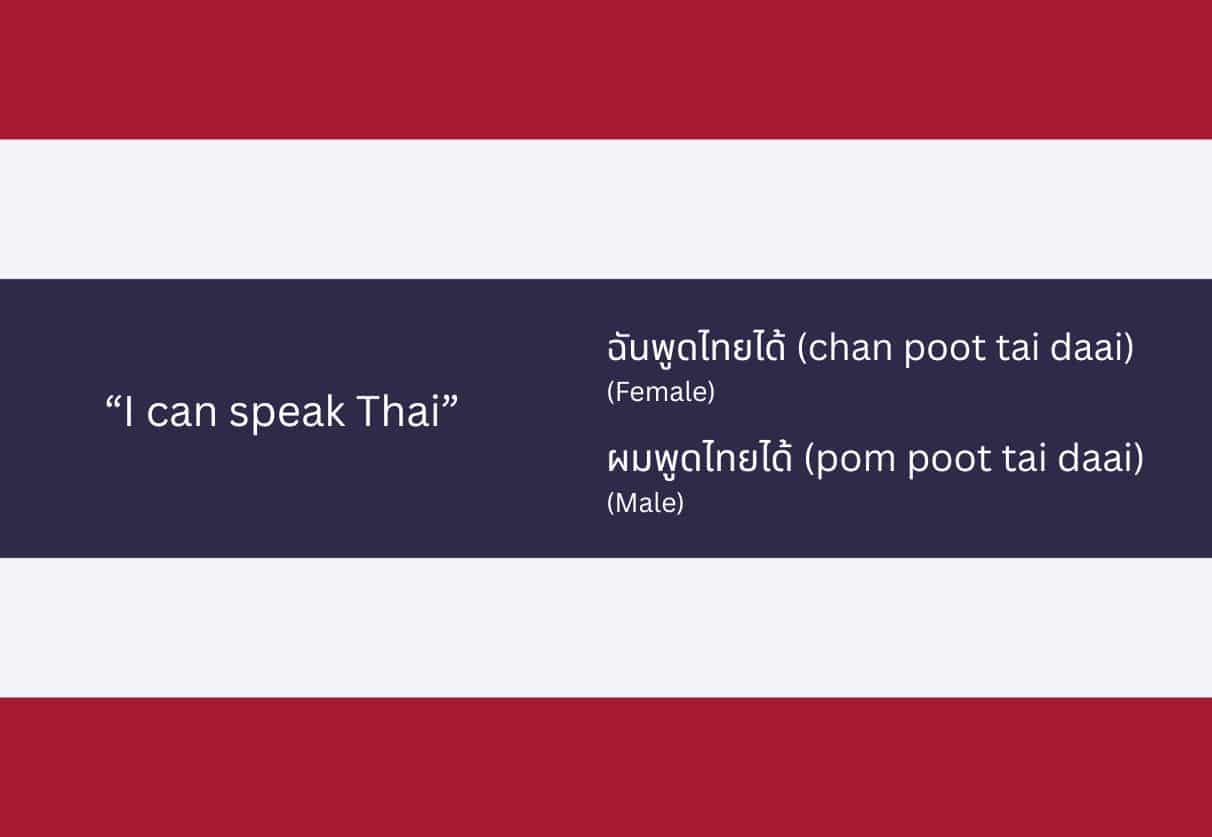
- If you are a male, then you would end your sentences with “khrup” (ครับ) (pronounced like “carp” with a soft/silent “r”, when spoken quickly, it can sound more like “cup”)
- If you are a female, you would end your sentences with “ka” (ค่ะ) (pronounced like “car”).
Doing this shows respect, is more polite than casual speech (which excludes ka and khrup), and is generally quite important in Thailand. Also, speaking with a smile is recommended!
Now that the basic politeness level is out of the way, let’s move on to some examples of Thai phrases for travel so you’re better prepared for your trip.
Some of the Most Helpful Thai Phrases For Travel in Thailand
Basics
Hello – สวัสดี (sawasdee) (casual)
Pronunciation: sah-wah-dee
If you are a woman, you would say: สวัสดีค่ะ (sa-wah-dee ka) (polite)
If you are a man, you would say: สวัสดีครับ (sa-wah-dee khrup) (polite)
- Yes – ใช่ (chai)
Pronunciation: chai (ch-eye)
Woman: ใช่ค่ะ (chai-ka) (polite)
Man: ใช่ครับ (châi khrup) (polite)
- No (General) – ไม่ใช่ (mai)
Pronunciation: my (my)
Woman: ไม่คะ (mai ka) (polite)
Man: ไม่ครับ (mai khrup) (polite)
- No (That’s not right) – ไม่ใช่ (mai chai)
Pronunciation: my chai (my ch-eye)
Woman: ไม่ใช่ะ (mai chai ka) (polite)
Man: ไม่ใช่ครับ (mai chai khrup) (polite)
- Thank you – ขอบคุณ (kop kun)
Pronunciation: kop kun (kop koon)
Woman: ขอบคุณค่ะ (kop kun ka)
Man: ขอบคุณครับ (kop kun khrup)
Food, Drinks & Ordering
When ordering food in Thailand, pointing and saying ‘เอาอันนี้ (ao an nee / ow an knee) is normal and rather common, especially at street food stalls. Even if you don’t know the exact name of a specific dish, this simple Thai phrase can get backpackers very far while they travel.
- I want this – เอาอันนี้ (ao an nee)
Pronunciation: ow an nee (ow an knee)
Woman: เอาอันนี้ค่ะ (ao an nee ka)
Man: เอาอันนี้ครับ (ao an nee khrup)
- One please – เอาหนึ่ง (ao neung)
Pronunciation: ow nung
Woman: เอาหนึ่งค่ะ (ao neung ka)
Man: เอาหนึ่งครับ (ao neung khrup)
- Delicious – อร่อย (a-roi)
Pronunciation: a-roy
Woman: อร่อยค่ะ (a-roi ka)
Man: อร่อยครับ (a-roi khrup)
- Not spicy – ไม่เผ็ด (mai phet)
Pronunciation: my pet
Woman: ไม่เผ็ดค่ะ (mai phet ka)
Man: ไม่เผ็ดครับ (mai phet khrup)
- A little spicy – เผ็ดนิดหน่อย (phet nit noi)
Pronunciation: pet nit noy
Woman: เผ็ดนิดหน่อยค่ะ (phet nit noi ka)
Man: เผ็ดนิดหน่อยครับ (phet nit noi khrup)
- Water – น้ำ (nam)
Pronunciation: nam (short, flat tone)
Woman: น้ำค่ะ (nam ka)
Man: น้ำครับ (nam khrup)
- Beer – เบียร์ (bia)
Pronunciation: bia
Woman: เบียร์ค่ะ (bia ka)
Man: เบียร์ครับ (bia khrup)
- The bill please – เก็บเงิน (gep ngern)
Pronunciation: gep gern (like the “ng” sound from “sing”, but at the start of the ngern word)
Woman: เก็บเงินค่ะ (gep ngern ka)
Man: เก็บเงินครับ (gep ngern khrup)
Transportation & Getting Around
For most transport options in Thailand (tuk-tuk and bus), you can often just show the location you’d like to reach on your phone or on a map, and the locals are usually very friendly and happy to help.
- Go to the airport – ไปสนามบิน (bpai sa-nam-bin)
Pronunciation: bye sa-nam-bin
Woman: ไปสนามบินค่ะ (bpai sa-nam-bin ka)
Man: ไปสนามบินครับ (bpai sa-nam-bin khrup)
ไป + [place] = “Go to [place]”
- Stop here – จอดที่นี่ (jot tee nee)
Pronunciation: jot tee nee
Woman: จอดที่นี่ค่ะ (jot tee nee ka)
Man: จอดที่นี่ครับ (jot tee nee khrup)
- Where is the bus station? – สถานีรถบัสอยู่ที่ไหน (sa-tha-nee rot bus yoo tee nai)
Pronunciation: sa-tha-nee rot bus yoo tee nigh
Woman: สถานีรถบัสอยู่ที่ไหนคะ (… ka)
Man: สถานีรถบัสอยู่ที่ไหนครับ (… khrup)
[place] + อยู่ที่ไหน = “Where is [place]?”
- Where is the hostel? – โฮสเทลอยู่ที่ไหน (hoh-stel yoo tee nai)
- Pronunciation: hoh-stel yoo tee nigh
- Woman: โฮสเทลอยู่ที่ไหนคะ (… ka)
- Man: โฮสเทลอยู่ที่ไหนครับ (… khrup)
In Thailand, โฮสเทล (hostel) is widely understood by locals, especially in backpacker-heavy regions. This makes it much easier to communicate, as you can often use the English pronunciation with the Thai sentence structure.
Numbers & Money
- Thai Baht (Thai currency) – บาท (baht)
Pronunciation: bat
In Thailand, many locals and visitors visit busy markets. It is common for travellers to be quoted with the “foreigner discount”, which usually includes higher prices than locals would be given. Unlike the Western world, it is also common for people to barter/haggle down prices a little bit.
- How much? – ราคาเท่าไหร่ (raa-kaa tao rai)
Pronunciation: raa-kaa t-ow r-eye
Woman: ราคาเท่าไหร่คะ (raa-kaa tao rai ka)
Man: ราคาเท่าไหร่ครับ (raa-kaa tao rai khrup)
- Can you lower the price? – ลดได้ไหม (lot dai mai)
Pronunciation: lot dye my
Woman: ลดได้ไหมคะ (lot dai mai ka)
Man: ลดได้ไหมครับ (lot dai mai khrup)
- I don’t understand – ไม่เข้าใจ (mai kao jai)
Pronunciation: my cow jai
Woman: ไม่เข้าใจค่ะ (mai kao jai ka)
Man: ไม่เข้าใจครับ (mai kao jai khrup)
In shopping areas and markets, prices are often said very quickly, which can be overwhelming to foreigners. If you’re unsure, you can always get out your phone calculator, which prompts the locals to show you figures (on their own calculator or yours) instead of just telling you them.
Social Life & Friendliness
Realistically, most backpackers and gap year travellers visiting Thailand are likely to communicate with other tourists in English. The phrases below are polite and helpful enough to help you communicate with the locals where necessary.
- Can you speak English? – พูดภาษาอังกฤษได้ไหม (pood paa-saa ang-grit dai mai)
Pronunciation: pood paa-saa ang-grit dye my
Woman: พูดภาษาอังกฤษได้ไหมคะ (… ka)
Man: พูดภาษาอังกฤษได้ไหมครับ (… khrup)
- Sorry / Excuse me – ขอโทษ (kor toht)
Pronunciation: kor toht
Woman: ขอโทษค่ะ (kor tot ka)
Man: ขอโทษครับ (kor tot khrup)
- Nice to meet you – ยินดีที่ได้รู้จัก (yin-dee tee dai roo-jak)
Pronunciation: yin-dee tee dye roo-jak
Woman: ยินดีที่ได้รู้จักค่ะ (… ka)
Man: ยินดีที่ได้รู้จักครับ (… khrup)
This phrase is quite formal, so it’s more appropriate for speaking to tour guides or staff and less so for quick chats with other backpackers.
- Where are you from? – คุณมาจากไหน (khun maa jak nai)
Pronunciation: koon maa jak nigh
Woman: คุณมาจากไหนคะ (… ka)
Man: คุณมาจากไหนครับ (… khrup)
Good for simple social interactions, but in many cases, locals may ask you this first.
Common Mistakes Travellers Make When Using Thai Phrases for Travel
Forgetting “khrup” and “ka”
One of the most common mistakes travellers make when using the Thai language is forgetting to use “khrup” for men and “ka” for women at the end of sentences.
These small words make your sentences sound polite and respectful, which is very important in Thai culture and will make people much more receptive to wanting to talk to you. When using Thai phrases for travel throughout the country, it doesn’t matter if your Thai isn’t perfect, but adding these words correctly will show you’re making an effort.
Being too direct
In English, people can sound polite regardless of the length of the sentence. It is unfortunately not the same in Thai. If you say something short without including the polite particles, it can feel too abrupt.
One example, saying:
- เอาอันนี้ (I want this)
Without adding khrup/ka can feel too direct and sometimes rude to locals.
Ignoring Tone Completely
Similar to Vietnamese, Thai is also a tonal language. This means that the way you say words can change their meaning.
That doesn’t mean you need to pronounce everything perfectly, but if you say everything very monotone and flat, it can sometimes confuse people.
If in doubt, try to reflect the tone and rhythm you hear, even if it’s not perfect.
Relying only on English
Although English is widely spoken in tourist areas, it’s not worth relying only on English if you want to communicate with locals. Once you step away from hostels and party streets, English is less widely spoken, so Thai becomes much more useful.
Luckily, in Thailand, locals are generally very friendly and appreciate any effort, even if you make mistakes.
Most of these mistakes are quite minor and come down to a lack of confidence and practice. This is why I advocate for travellers to learn basic words and travel phrases before their gap year or long trip.
The best way to do this is by working with a native speaker to give you the run-down on the most important words and phrases, including context, realistic situations and correct pronunciations, so you can have the confidence to communicate during your time in the Kingdom of Thailand.
To speak to a native Thai speaker, you can use a platform I have used for the last few years for some of my own trips, Preply. At the time of writing, there are 208 Thai tutors offering one-on-one classes to those who want to prepare for their upcoming trip.
With this link, you can get 30% off on your first trial lesson, and you’ll have the flexibility to arrange one class or ongoing regular classes on a weekly basis.
Can You Get By With Just English in Thailand?
If, like me, you’re travelling from an English-speaking country, it is a fair concern to wonder if you can get by in Thailand without knowing the language, and the answer is rather nuanced.
Technically, if you only visit tourist-heavy regions or are only in the country for a week or so, then yes, you could likely manage without much Thai. However, if you’re planning on travelling throughout the country, visiting rural areas, and spending more than 7 days in the Kingdom, then you’ll be much better off knowing some basic Thai phrases to enhance your travel experience.
Even in Bangkok and Chiang Mai, the two largest cities, basic thai phrases are useful for travel as not every part of the cities are deemed “touristy”. There are some areas that attract tourists in which it’s common to meet locals who speak pretty good English, but if you trail into the residential areas or parts of the city most tourists don’t reach, then you might struggle to get by with just the one language.
Why Learning Thai is Worth it for Gap Year Travellers and Backpackers
So, this is probably the 2nd most important section of the article (after the Thai phrases for travel, of course), as you likely want to know why it’s beneficial for you, as a gap year backpacker, to learn some Thai.
What makes learning Thai so unique compared to many other languages is that even a tiny amount of communication in the local language can go a long way. Thailand is already known worldwide as a super-friendly country, but when you make the effort to speak even just a few words in Thai, the locals greatly appreciate it.
Whether you’re shopping at a night market, ordering at a street food stall, asking for directions or checking into a hostel, those small interactions between you and the locals become smoother and create a generally more enjoyable experience.
Unlike short-term tourists who visit for just 1 week, gap year travellers are more likely to:
- Travel between different regions
- Visit less touristy areas
- Stay longer in the country
- Interact more with locals
In these situations, relying solely on English becomes less practical, and even basic Thai phrases can make a noticeable difference to your confidence and independence.
Also consider that basic phrases will only take you so far. Even if you can say the phrases above, you may not be able to understand the responses.
That’s where lessons can be really useful. Being matched with a tutor who can create lesson plans specifically based on “travel” and common tourist situations, you’ll put yourself in a much better position to hold simple conversations and be more likely to understand common responses.
If you’re ready to start your Thai language journey for your future trip, check out Preply, pick a tutor that seems to match your goals best, and give it a try!
Remember, you get 30% off your first trial lesson using my link.
Need help planning your trip?
Check out how to plan a trip abroad & see my travel resources for more.
Skyscanner – A comprehensive comparison website showing where to purchase flights.
HostelWorld – The biggest selection of hostels & sociable accommodations.
Booking.com – The largest collection of accommodations AND flights worldwide.
Safety Wing – A travel insurance brand for long-term travellers and nomads.
Airalo – An eSIM card company that lets you stay connected during your trip.
Wise – Perfect for transferring foreign currencies.
iVisa – For applying for tourist and visitor visas.
Viator – Great for finding tours and activities worldwide.
Get Your Guide – Another company for finding activities.
Klook – Have some of the best activity deals in Asia.